The Earth, Space and Antarctica.
Proponents of a young earth calculate its age by tracing the genealogical lineages, lifespans, and historical markers recorded in the Old Testament, most notably in the Book of Genesis. Starting from the account of creation in Genesis, where the universe and all life are formed in six literal 24-hour days, scholars such as Archbishop James Ussher in the 17th century calculated a timeline placing creation around 4004 BCE. By adding the ages of the patriarchs from Adam through Abraham, and aligning subsequent biblical events with secular historical dates, creationist chronologists arrive at a total age for the earth of roughly 6,000 to 7,200 years. In this framework, genealogies are viewed as strict historical records rather than allegorical or telescoping representations of time, leaving no room for the multi-million-year epochs required by standard modern geology and evolutionary biology.
Within this historical framework, dinosaurs are understood not as creatures that lived tens of millions of years ago, but as part of the terrestrial animal life created by God on Day Six of the Genesis creation week, alongside humanity. Because humans and land animals were created on the same day, they coexisted. Proponents suggest that large reptiles grew steadily throughout their lives, a characteristic seen in many reptiles today, and could achieve immense sizes due to pre-flood environmental conditions, such as a hypothesized higher atmospheric canopy or increased oxygen levels.
According to this model, dinosaurs did not go extinct millions of years before humans; rather, representatives of these kinds were brought aboard Noah’s Ark to survive the global cataclysm of the Genesis Flood. After the Flood, the drastically altered post-diluvian climate, reduced lifespan, human hunting, and changing ecological pressures led to the eventual decline and extinction of most dinosaur species, with some surviving into historical times as creatures described in ancient folklore, mythology, and texts (such as the descriptions of behemoth and leviathan in the Book of Job)
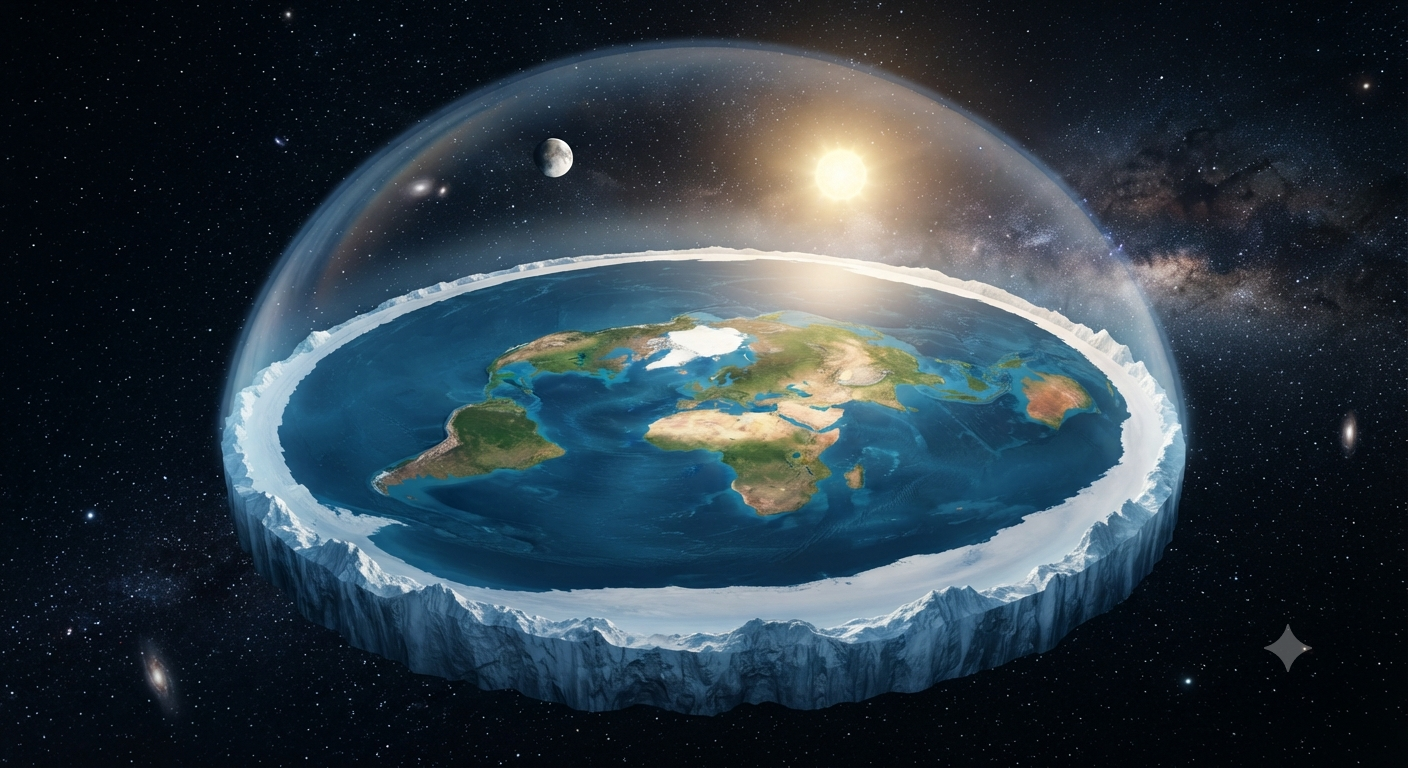
Expanding upon a strictly literal reading of ancient Near Eastern cosmological descriptions in scripture, some proponents within alternative creationist movements also advocate for a geocentric, enclosed flat earth model, rejecting modern astrophysical concepts of a heliocentric solar system and deep space. This model interprets biblical passages describing the "pillars of the earth," the "circle of the earth," and a solid firmament (or dome) separating waters above from waters below as physical realities rather than poetic metaphors.
In this framework, the earth is described as a stationary, enclosed plane. The sun, moon, and stars are not millions of light-years away in a vast vacuum, but are relatively small, localized luminaries moving within or just beneath the firmament. Consequently, outer space as described by modern astronomy, featuring billions of distant galaxies, expanding space-time, and planetary bodies millions of light-years away, is viewed by proponents of this model as a theoretical construct unsupported by direct, unmanipulated human observation, arguing instead that physical experiments (such as water level tests and the absence of measurable curvature) point to a flat, stationary domain tailored specifically for human habitation..
The Masoretic vs. Septuagint Textual Traditions: Depending on which ancient manuscript tradition is utilized, minor variances emerge. The standard Hebrew Masoretic text places creation roughly around 4004 BCE (as famously calculated by 17th-century Archbishop James Ussher in his Annales Veteris Testamenti). However, the Greek Septuagint and the Samaritan Pentateuch contain different chronological numbers for the ages of the patriarchs at the birth of their sons, which can stretch the timeline by an additional 1,000 to 1,500 years, pushing the creation date back to around 5500 BCE. Nonetheless, both traditions restrict the age of the earth to a few thousand years rather than billions.
Genesis 1, the Hebrew word yom is used alongside the phrases "evening and morning." Creationists argue that whenever yom is used in the Old Testament with a numerical adjective or the evening/morning modifier, it invariably means a literal 24-hour solar day.
Proponents argue that the genealogies in scripture are tightly closed, meaning there are no intentional gaps or "telescoping" generations (where a grandfather is called a father). By adding the lifespans from Adam to Abraham, and then mapping the historical kings of Israel and Judah against secularly dated events (such as the battle of Qarqar or the reign of Nebuchadnezzar II), chronologists construct a continuous, unbroken ledger of human and planetary history.
The coexistence of humans and dinosaurs, followed by their eventual demise, is explained through specific environmental models of the pre-flood world.
The Vapor Canopy Model: Formulated by creationist scientists (such as Joseph Dillow in The Waters Above), this model proposes that prior to the global flood, the earth was surrounded by a transparent canopy of water vapor or ice suspended high in the atmosphere. This canopy would have acted as a global greenhouse, creating a uniform, temperate, sub-tropical climate from pole to pole. It would also have filtered out harmful cosmic radiation and ultraviolet rays, which proponents argue is the primary biological reason why pre-flood patriarchs lived for over 900 years.
Indeterminate Growth in Reptiles: Unlike mammals and birds, which stop growing when they reach maturity, reptiles exhibit indeterminate growth, meaning they continue to grow larger for as long as they live. In the hyperbaric, oxygen-rich, and shielded environment of the pre-flood canopy, ancient reptiles (including what we classify as dinosaurs) could live for centuries, reaching massive proportions.
Survival on the Ark: Regarding how massive creatures like Brachiosaurus or Tyrannosaurus rex fit on Noah’s Ark, creationist zoologists argue that Noah did not need to take fully grown, geriatric adults. Instead, he took younger, adolescent specimens, which were smaller, required less food, and had plenty of room to grow post-flood. Furthermore, proponents emphasize the distinction between modern species and biblical "kinds" (baramin); only two representatives of each basic kind (such as a dog kind or a dinosaur kind) were required, meaning there were likely only around 50 to 70 pairs of dinosaur-like creatures on the vessel.
The physical reshaping of the earth is attributed entirely to a year-long cataclysmic event rather than millions of years of slow, uniform geological processes.
Catastrophic Plate Tectonics (CPT): Developed by geophysicist John Baumgardner, CPT is a young-earth alternative to standard plate tectonics. It proposes that at the onset of the Genesis Flood, the oceanic crust broke apart and rapidly subducted into the earth's mantle at high speeds. This catastrophic movement released immense thermal energy, boiled the oceans, triggered global volcanic activity, and caused the continents to race across the globe in a matter of weeks, rapidly lifting up modern mountain ranges like the Himalayas and the Rockies while burying billions of plants and animals in thick sedimentary layers.
Rapid Fossilization: Within this paradigm, the fossil record is not a chronological evolutionary timeline of millions of years, but rather an ecological burial sequence. The bottom layers represent shallow marine environments swept away first, followed by lowland terrestrial animals (including dinosaurs), and finally higher-altitude mammals and humans. The immense water pressure and mineral-rich sediment facilitated rapid fossilization, bypassing the need for millions of years of gradual deposition.
Post-Flood Extinction: Following the recession of the floodwaters, the vapor canopy was gone, atmospheric pressure and oxygen levels dropped, and the post-diluvian climate became harsher and more seasonal (initiating a brief, centuries-long Ice Age driven by warm post-flood oceans). These drastic environmental changes, combined with intensive hunting by post-flood human populations for survival and protection, led to the rapid starvation, environmental stress, and ultimate extinction of most dinosaur populations within a few centuries
A subset of alternative creationists also adopt a geocentric, enclosed flat earth framework, entirely reinterpreting the structure of the cosmos.
The Biblical Blueprint of the Cosmos: This model relies on ancient Near Eastern cosmological descriptions found throughout the poetic and historical books of the Bible. The earth is viewed as an immovable plane set upon "pillars" (1 Samuel 2:8). Above the earth sits the raqia, rendered as a solid physical dome or firmament in ancient Hebrew cosmology, which separates the waters above the dome from the waters and land below (Genesis 1:6–7).
Mechanics of the Luminaries: In this enclosed system, the sun, moon, and stars are not massive celestial bodies millions of light-years away operating in a vacuum. Instead, they are localized, smaller lights moving in circuits underneath or within the lower reaches of the firmament. Eclipses are explained not by planetary shadows or lunar crossings in deep space, but by a third, dark celestial body (sometimes called the "shadow object" or dark luminary) passing in front of the sun or moon.
Rejection of Modern Physics and Space Agencies: Proponents of this view argue that outer space is a theoretical construct rather than an observable reality. They claim that physical laws observed in laboratory settings, such as gas laws requiring a solid container to maintain pressure next to a vacuum, invalidate the concept of an infinite, pressureless outer space adjacent to earth's atmosphere. Consequently, gravity is often reinterpreted as buoyancy and density (objects fall because they are denser than the medium surrounding them), water is asserted to always maintain a flat, level surface without measurable curvature, and historical space programs are viewed as operating entirely within atmospheric constraints (such as low-earth orbit or parabolic flights) rather than traveling through an interstellar void.
Within alternative cosmological frameworks that reject standard astrophysics, the argument that outer space does not exist is built on a specific set of physical, visual, and institutional critiques. Proponents of this perspective contend that the modern concept of an infinite universe filled with distant planets, galaxies, and a vacuum of space is a constructed narrative supported by manipulated evidence.
The core arguments used to support the claim that space is a fabricated concept focus on several key areas:
1. The Thermodynamic Vacuum Problem
A foundational argument relies on classical thermodynamics and gas laws, particularly the behavior of pressurized gases adjacent to a vacuum.
The Gas Law Dilemma: Proponents point out that the Earth possesses a dense, pressurized atmosphere containing oxygen, nitrogen, and other gases. According to the laws of physics, a high-pressure system will always rush to fill an adjoining low-pressure system or vacuum until equilibrium is reached, unless separated by a physical, solid barrier.
Absence of a Physical Container: In standard astrophysics, gravity is said to hold the atmosphere to a spinning globe without a physical container, separating it from the vacuum of space. Alternative cosmology rejects this, arguing that gravity is an unproven force too weak to overcome the expansive properties of gas. Therefore, they conclude that a pressurized atmosphere cannot exist next to an infinite vacuum, necessitating either a physical dome (the biblical firmament) or rendering the idea of outer space physically impossible.
2. Allegations of Visual Fabrication and CGI
Proponents heavily scrutinize imagery, video feeds, and broadcasts provided by space agencies like NASA, ESA, and SpaceX, arguing that they show signs of artificial manipulation.
CGI and Composite Imagery: Space agencies openly state that many images of Earth and distant nebulae are "composites" or color-enhanced data visualizations rather than raw photographs. Skeptics interpret this admission as proof that the imagery is entirely fabricated or artistically rendered rather than captured by cameras in space.
Anomalies in Live Footage: Proponents frequently analyze live streams from the International Space Station (ISS) for visual anomalies, such as harness lines during supposed spacewalks, bubbles floating in zero-gravity footage (which they argue indicate filming underwater in training pools like NASA's Neutral Buoyancy Laboratory), and alleged green-screen glitches where parts of an astronaut's suit or equipment disappear against the background.
3. The Van Allen Radiation Barrier Argument
The logistical and biological hurdles of passing through Earth's radiation belts are often cited as evidence that deep space exploration is unachievable.
Lethal Radiation Levels: Discovered in 1958, the Van Allen radiation belts are zones of energetic charged particles trapped around the Earth by its magnetic field. Proponents of space skepticism argue that the radiation levels within these belts are intensely lethal to biological life and delicate electronics.
The Apollo Era Skepticism: Critics argue that the technology of the 1960s during the Apollo moon landings was insufficient to shield astronauts from these intense radiation bands, leading to the conclusion that crewed missions beyond low-earth orbit could not have taken place at that time.
4. Antarctica and the Institutional Monopoly on Exploration
The restriction of independent, unrestricted civilian travel to Antarctica plays a central role in alternative cosmological theories.
The Antarctic Treaty of 1959: Proponents view the international treaty governing Antarctica with deep suspicion, arguing that it exists not to protect an environmental ecosystem or scientific sanctuary, but to prevent independent explorers, private vessels, and commercial flights from freely navigating the region.
The Ice Rim Hypothesis: In a flat earth framework, Antarctica is not a continent situated at the bottom of a globe, but rather a massive ring of ice cliffs that holds in the world's oceans. Within this view, the strict governmental control of the territory is framed as an effort to prevent the public from discovering the literal "edge" or barrier of the known world, thereby maintaining the globe model and the illusion of outer space.
Within alternative flat earth and enclosed-world cosmological models, the geography of the earth does not terminate at the known southern coastline of Antarctica. Instead, the ice sheet is viewed as a transition zone leading to vast, hidden territories existing beyond the barrier. This concept relies heavily on cartographic interpretations, historical expedition narratives, and a specific reading of the United Nations emblem.
The United Nations Map and Azimuthal Projection
The official emblem and flag of the United Nations, adopted in December 1946, features a world map centered on the North Pole and enclosed by olive branches.
The Projection Type: Mainstream cartography identifies this as an azimuthal equidistant projection, a standard mathematical method used to flatten a 3D spherical globe onto a 2D plane, where the North Pole is at the center and lines of longitude radiate outward. In this projection, the southern polar region is necessarily stretched to form a massive ring that encircles the entire perimeter of the map.
The Alternative Interpretation: Proponents of an enclosed flat earth framework reject the idea that the UN map is merely a mathematical projection of a globe. Instead, they argue that it represents a literal, unrolled depiction of the earth's true layout. In this view, the circular white border at the edge of the UN emblem is not a distorted Antarctica, but an accurate representation of the literal ice barrier holding the world's oceans in place, with the continents splayed out across a central disc.
Beyond the Ice Wall: Proposed Extra-Territorial Lands
In alternative geocentric and "expanded flat earth" lore (such as popular cartographic concepts like Terra Infinita), what lies past the Antarctic ice barrier is the subject of extensive speculation, drawing from mythologies, lost continents, and conspiracy theories.
Beyond-the-Wall Geography: Proponents theorize that the Antarctic ice shelf is not a few miles thick, but a massive, towering ring of jagged ice hundreds or thousands of miles wide. They claim that past this frozen expanse lie entirely new continents, hidden oceans, and forbidden lands completely omitted from modern geographical maps.
Historical and Mythical Precedents: Narrative frameworks surrounding these "outer lands" often incorporate ancient myths of Hyperborea, lost polar continents, or hidden terrestrial realms described in esoteric literature. Proponents suggest that explorers like Admiral Richard E. Byrd, whose mid-20th-century flights into Antarctica encountered intense media and military focus, discovered vast expanses of traversable land, warm microclimates, or mountain ranges stretching far beyond the known ice rim, which were subsequently classified or suppressed by international governments.
The Geopolitical Lockdown and the Antarctic Treaty
The comprehensive international regulation of Antarctica is interpreted within these models as a deliberate strategy of containment and secrecy.
The 1959 Antarctic Treaty System: Restricting military activity, establishing scientific-only zones, and requiring prior authorization for independent travel to the continent are viewed by alternative theorists not as environmental protections, but as a total travel blockade.
Enforced Isolation: Proponents argue that independent civilian vessels or aircraft attempting to approach or bypass the Antarctic perimeter without governmental clearance are intercepted or turned away by naval forces acting under international consensus. Consequently, they claim that the geopolitical monopoly over Antarctica functions to prevent the general population from verifying what, or who, might exist beyond the borders of the known world map.
In summary, this worldview presents a complete alternative framework to modern mainstream science by uniting a literal biblical chronology, dating the Earth to roughly 6,000 to 7,000 years old with a catastrophic global flood that reshaped geology and buried dinosaurs, with an enclosed, geocentric cosmology where the earth is a stationary plane, outer space is a fabricated concept, and Antarctica serves as a heavily guarded ice barrier concealing uncharted lands beyond.