God, is not Dark matter.
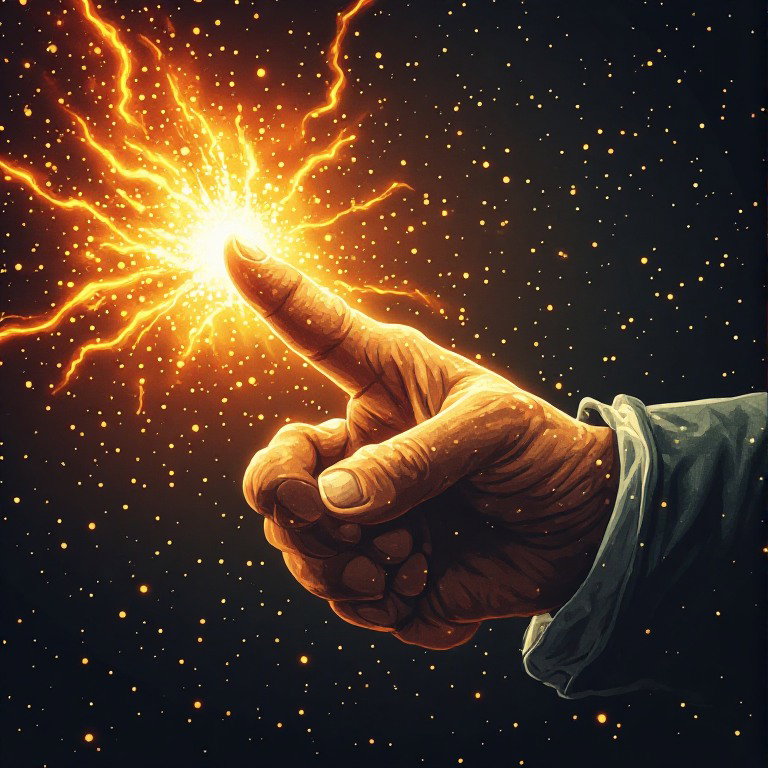
To contemplate the genesis of our universe through a purely rationalist lens requires us to step away from the comforting scaffolding of empirical observation and instead interrogate the fundamental logic of existence. If we accept the premise of the Big Bang as the definitive dawn of spacetime, we are forced by the laws of pure causality to look beyond the cosmic horizon for its origin. A system cannot define its own beginning; a state of absolute nothingness possesses no intrinsic mechanism to spontaneously transition into everything. Therefore, the initiation of the universe cannot be understood as an internal event generated by a reality that did not yet exist. It demands an external force, a prime mover or a transcendental causal agent operating outside the constraints of our specific dimensions of time and space, known as God the Father, to pierce the void and dictate the first inflection point of reality. Without this exterior impetus, the potentiality of existence would have remained perpetually dormant, lacking the necessary foreign catalyst to compel it into being.
Expanding upon this philosophical necessity, the idea of an isolated system generating its own physical laws from absolute zero is a logical contradiction. Every effect we can conceive of is merely a link in an unbroken chain of prior causes, meaning the very first link cannot be forged by the chain itself. The Big Bang represents a profound rupture in non-existence, an sudden inflation of energy and dimension that could only be achieved if a force existing independently of our universe’s eventual physics exerted a definitive influence upon the threshold. This external force must possess an ontological priority, existing in a realm where the rules of our universe do not apply, thereby allowing it to serve as the uncaused cause. To argue otherwise is to suggest that the universe pulled itself into existence by its own metaphorical bootstraps, an assertion that defies the foundational architecture of reason.
When we turn this same rigorous skepticism toward the modern construct of dark matter, the idea of it being a literal, physical state of matter begins to dissolve under philosophical scrutiny. The conceptualization of dark matter is, at its core, an inversion of what is fundamentally plausible. It represents a theoretical band-aid designed to preserve flawed internal equations rather than a coherent extension of physical reality. To propose a form of matter that constitutes the overwhelming majority of the cosmos, yet remains entirely unobservable, non-interactive with light, and utterly ghost-like, is to redefine "matter" into something that is the exact opposite of its definition. Matter is that which occupies space and interacts within a framework of mutual feedback; to invent a substance defined almost entirely by its refusal to engage with the observable universe is to substitute a mechanical explanation with a metaphysical ghost.
Ultimately, attributing the anomalies of cosmic motion to an invisible, undetectable state of matter is far less plausible than acknowledging a fundamental misinterpretation of the system's underlying dynamics. Instead of a hidden substance anchoring the galaxies from within, it is far more coherent to view these gravitational discrepancies as the lingering ripples of that original, external causal force. By forcing the universe to account for its own missing mass through the invention of dark matter, contemporary thought mistakenly looks inward for answers that can only be found outward. The implausibility of dark matter lies in its role as a cosmic placeholder, masking the truth that the architecture of the universe is not self-sustaining or self-explanatory, but is continuously responding to the geometric dictates of the external force that authored it.
To push the boundaries of this rationalist framework even further, we must dissect the very mechanics of how an external force interfaces with a nascent universe. If the Big Bang marks the absolute genesis of our spacetime metric, then the external force cannot be thought of as a physical entity pushing from the "outside," for there was no "outside" spatial dimension to occupy. Instead, this force must be understood as an ontological priority—a framework of pure logic, potential, or transcendental geometry that preceded the physical manifestation of dimensions.
In classical logic, a transition from a state of absolute non-being to being requires a sufficient reason for the transition to occur at that specific "moment" rather than any other. Because time itself was created in the expansion, the external force must exist in a state of atemporality. It did not sit in a void waiting for a billion years to strike; rather, the force is the perpetual substrate upon which the possibility of the universe hangs. It acts as a cosmic boundary condition, imprinting the initial parameters ,the fundamental constants and the specific curvature of reality, onto the initial singularity. The Big Bang, therefore, is not an explosion in space, but the violent translation of an external, metaphysical architecture into a physical, dimensional medium.
When we subject dark matter to this deeper level of scrutiny, its conceptual framework reveals a profound paradox. In traditional philosophy, a thing is defined by its interactions; a entity that has no properties of interaction effectively does not exist.
By defining dark matter as a substance that possesses mass but completely lacks the ability to interact via the electromagnetic, strong, or weak nuclear forces, we are creating a logical hybrid that violates the unity of nature. It asks us to accept a state of matter that is simultaneously:
Immanent: It is physically here, choking the galaxies and dominating the cosmic mass profile.
Transcendent: It is utterly untouchable, passing through stars and human bodies as if they were ghosts.
This is the opposite of what is plausible because it requires a dualistic reality where two entirely different categories of physical existence occupy the same coordinates without ever acknowledging one another, save for a passive gravitational pull. To invent an entirely new, invisible ecosystem of particles just to balance a localized mathematical equation is an act of theoretical desperation. It treats the universe as a closed, self-contained box that must contain its own answers.
If we reject the inward-looking hypothesis of dark matter, the alternative is far more elegant: the anomalous rotation of galaxies and the bending of light are not caused by hidden ghosts inside the universe, but by the structural memory of the external force that birthed it.
If an external force dictated the initial expansion, the fabric of spacetime itself was likely imparted with an intrinsic, non-Euclidean geometry, a fundamental warp or a built-in acceleration profile that does not rely on local mass to exist. What we mistake for the gravitational pull of "dark matter" is actually the universe continuing to conform to the deep, invisible grooves cut into reality by the original causal agent. The extra gravity isn't coming from invisible particles; it is a lingering geometric echo of the external force, a continuous pressure exerted by the framework that holds our universe in existence.
God the father, is that force.