The Circle and The Hollow Crown - The Story
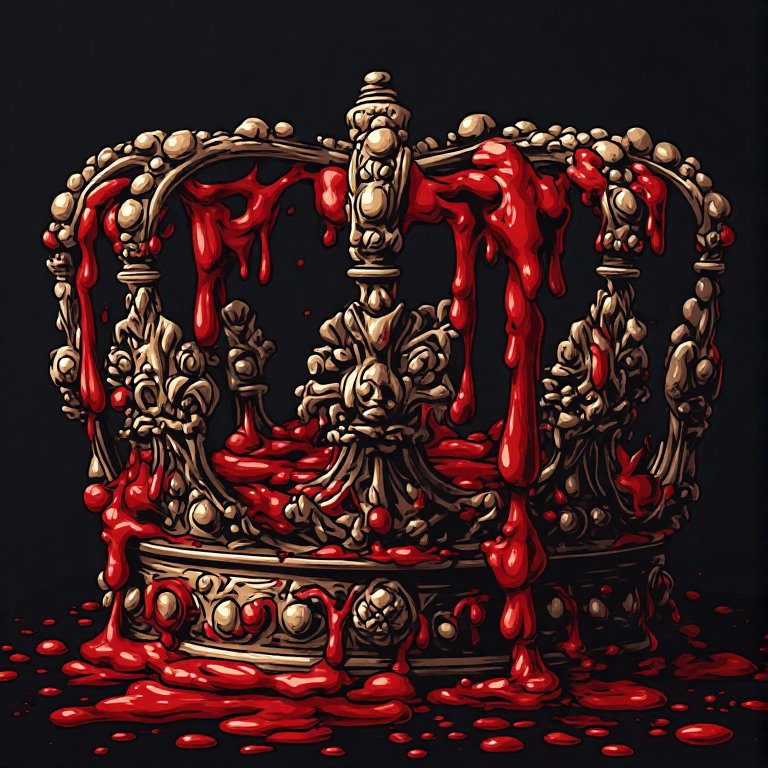
In a world where wealth had become indistinguishable from power, and power had long since divorced itself from morality, humanity lived beneath an invisible empire. It was not governed by any single president, monarch, or parliament, but by a clandestine assembly of extraordinarily wealthy individuals who operated behind the immaculate facades of international finance, private healthcare, food conglomerates, and political institutions. They were the architects of a civilization that appeared, to the ordinary observer, to be advancing toward unprecedented prosperity. Cities glittered beneath towers of mirrored glass, artificial intelligence promised an age of abundance, and advertisements proclaimed that humanity had finally conquered the ancient burdens of hunger, disease, and aging. Yet beneath this polished exterior, something profoundly sinister had taken root. The world had not conquered its darkest impulses. It had merely learned to conceal them beneath the language of progress.
Behind closed doors, however, the Circle pursued an obsession that had consumed its members for generations: the conquest of mortality. Ordinary wealth could purchase comfort, influence, and almost limitless opportunity, but it could not permanently arrest the passage of time. The Circle's oldest members had watched their predecessors weaken, deteriorate, and die despite possessing fortunes greater than those of entire nations. They regarded death not as an unavoidable feature of existence but as an unacceptable limitation imposed upon lesser beings. Their laboratories, hidden beneath private medical complexes and isolated research estates, became the setting for increasingly grotesque experiments. Among the Circle's most closely guarded beliefs was the notion that the blood of the young, particularly blood associated with intense physiological responses, contained some extraordinary property capable of restoring vitality. They transformed speculation into dogma, and dogma into a justification for atrocities. Whether their theories possessed any scientific merit became almost irrelevant to them. The pursuit itself had become a religion, and the bodies of the powerless its sacrificial altar.
the Circle's obsession with youth gave rise to a clandestine trafficking network that reached into the most vulnerable corners of society. Children disappeared from neglected communities, unstable households, refugee settlements, and regions devastated by war. Some were abducted by criminal intermediaries; others were lured by promises of education, employment, shelter, or a better life. The network did not resemble a single criminal organization with a recognizable headquarters. It functioned as a chain of compartmentalized operations, each participant aware of only a fraction of the larger enterprise. Forged documents obscured identities, corrupt officials delayed investigations, and transportation companies moved people across borders under the appearance of ordinary commercial activity. Whenever a child vanished, the machinery of bureaucracy offered an endless supply of excuses: a misplaced record, an uncooperative jurisdiction, an incomplete report, or an investigation that had inexplicably lost its funding.
The most disturbing feature of the system was not simply the violence it inflicted, but the manner in which it converted human suffering into administrative routine. A child could become a missing-person statistic, a line in a confidential ledger, or an anonymous entry in a database whose records were accessible only to individuals with carefully restricted credentials. Each disappearance was separated from the next by geography, language, and institutional indifference. Families were left to navigate a maze of unanswered telephone calls and contradictory explanations, while officials reassured the public that the appropriate procedures were being followed. In time, the absence of evidence became a weapon against those seeking answers. The families' grief was dismissed as speculation, their suspicions portrayed as hysteria, and their demands for accountability characterized as threats to public order. The Circle understood that its greatest protection was not secrecy alone. It was a society trained to mistake the absence of proof for proof that nothing had happened.
Within the story, a handful of corporations controlled by the Elysian Circle exploited that crisis to conceal an unspeakable criminal enterprise. Their most sinister operations involved the illicit handling of human remains and the falsification of supply records, practices disguised through layers of subcontractors, fraudulent certifications, and compromised inspectors. The narrative surrounding the scheme became almost impossible to separate from the public's legitimate fears about food security. When rumors surfaced, the companies issued polished denials and commissioned investigations whose conclusions were released only after public attention had moved elsewhere. A few whistleblowers vanished from professional life. Others were discredited through manufactured scandals. The public continued eating in brightly illuminated restaurants, ordering inexpensive meals from glowing digital menus, and trusting the familiar logos printed upon paper wrappers.
Yet the horror did not depend upon graphic descriptions of its crimes. Its deepest terror lay in the contrast between the ordinary experience of consumption and the monstrous system that the Circle allegedly concealed. A family celebrating a birthday in a fast-food restaurant could unknowingly occupy the same commercial world as executives who had authorized atrocities. A delivery driver could transport sealed containers without understanding their contents. An auditor could approve a report because every required document appeared complete. Thousands of employees might participate in the operations of a corporation without possessing the slightest awareness of its darkest secrets. Evil had become distributed across a vast economic system, divided into tasks so ordinary that no single participant appeared to control the whole. The Circle had discovered that a sufficiently complicated institution could make monstrous conduct look like an accounting discrepancy.
At the center of the conspiracy stood an island that appeared on no publicly accessible navigation chart.
Sailors in remote waters occasionally spoke of a narrow band of fog that persisted even under otherwise clear skies. Satellite images of the surrounding ocean sometimes revealed unexplained interruptions in the data, while privately owned vessels reported navigational instruments behaving erratically near a particular stretch of open water. The island possessed no official name. Within the Circle, it was known as the Hollow Crown.
From a distance, the Hollow Crown looked almost beautiful. Black cliffs rose above a restless sea, their surfaces carved by centuries of wind and salt. Dense vegetation covered the island's interior, concealing a landscape of steep ravines, abandoned stone structures, and buildings constructed from pale rock that seemed to glow beneath the moon. There was no commercial harbor, no tourist accommodation, and no permanent settlement acknowledged by any government. Yet beneath the island stood a complex of private chambers, ceremonial halls, and fortified passageways connected to a secluded landing facility. Its architecture blended the appearance of an ancient sanctuary with the cold precision of a modern security installation.
Once each year, according to the fragmented accounts of former insiders, the most powerful members of the Elysian Circle gathered there for a private convocation. They arrived aboard vessels registered through obscure holding companies, leaving their public identities behind along with their telephones, assistants, and carefully managed reputations. The gathering was called the Night of Renewal. Its official purpose was described within the organization as a ceremony of continuity, an affirmation that the Circle existed beyond the lifespan of any individual member. Its actual significance was far more sinister: it reinforced the shared secrets that bound the participants together and reminded each of them that departure would mean exposure, disgrace, and potentially imprisonment.
At the island's center stood a circular chamber known as the Hall of Ashes. Its walls were covered with symbols borrowed from civilizations whose beliefs the Circle scarcely understood, appropriated and rearranged to create an artificial mythology of eternal life. Black candles illuminated a stone platform beneath a ceiling painted to resemble a starless sky. Around the chamber stood statues of rulers, philosophers, and conquerors, their faces altered until they seemed less like historical figures than expressions of timeless authority. Here, the Circle conducted its forbidden ceremonies, invoking renewal, dominion, and the supposed right of the powerful to transcend the moral limitations imposed upon everyone else.
The island's true purpose, therefore, was not merely to provide a secluded location for atrocities. It was the psychological heart of the organization. Away from cameras, courts, and public scrutiny, the Circle rehearsed its central delusion: that extraordinary wealth placed its members outside the human condition. Their private rituals converted fear into spectacle and criminality into belonging. They could return from the island to deliver speeches about childhood welfare, sign international agreements, and pose for photographs beside hospital beds, all while carrying the knowledge of what they had permitted within the Hollow Crown. Their public identities and private actions existed in separate compartments, and the distance between those compartments became the foundation of their power.
In the final chapter, the Hollow Crown remained on the horizon, its dark cliffs battered by the ocean. The Hall of Ashes stood empty, its ceremonial decorations exposed beneath the harsh light of investigators' lamps. The island's mythology had collapsed, leaving behind only physical evidence, unanswered questions, and the consequences of human decisions. The Circle's members had once imagined themselves as custodians of a secret that would elevate them above ordinary humanity. Instead, they had constructed a prison of their own making, sustained by fear and threatened by the possibility that someone, somewhere, would finally speak.
And that was the ultimate revelation of The Feast of Shadows: the most dangerous monsters in such a world would not necessarily look monstrous. They would wear immaculate suits, sponsor charitable foundations, deliver eloquent speeches, and surround themselves with people who insisted that their success proved their virtue. Their greatest weapon would be the public's reluctance to believe that respectable appearances could conceal terrible crimes.
Their greatest weakness would be the people they had underestimated—the families who kept searching, the workers who began asking questions, the investigators who refused to close their files, and the witnesses who chose truth over silence.
For even in a world seemingly ruled by those who believed themselves beyond judgment, power could not guarantee eternity. Secrets could be exposed. Institutions could be challenged. And the people whom the powerful had reduced to invisible entries in private ledgers could once again become what they had always been: human beings whose lives mattered, whose suffering demanded recognition, and whose dignity no fortune could rightfully purchase or destroy.
The world did not fall into darkness in a single night. There was no declaration of martial law, no sudden invasion, no identifiable moment when humanity collectively surrendered its freedom to an unseen authority. Instead, the transformation unfolded over generations, advancing through a thousand apparently unrelated decisions until the machinery of civilization had been quietly rearranged around the interests of a select few. Elections continued. Governments changed. Financial markets rose and collapsed. Wars began under the banners of national security, while peace agreements were celebrated beneath the flags of international cooperation. To the ordinary citizen, history appeared chaotic, driven by competing ideologies, economic cycles, and the unpredictable ambitions of political leaders.
Its members occupied no single throne. Instead, they held positions at the intersections of finance, biotechnology, international commerce, private security, media ownership, and political influence. Their power was distributed across institutions that appeared independent but frequently relied upon the same investment networks, legal advisers, philanthropic foundations, and private intermediaries. A decision made in one boardroom could influence the funding of a research institution on another continent, alter the priorities of a government agency, and determine which stories received attention in the international press.
The Circle rarely needed to issue explicit commands. Its preferred method was to make certain outcomes financially attractive, professionally advantageous, or politically unavoidable. A regulator who threatened a profitable enterprise might discover that future employment opportunities had mysteriously disappeared. A journalist investigating a powerful corporation might face an expensive lawsuit. A researcher who questioned a lucrative scientific program might find institutional funding withdrawn. No single action necessarily appeared criminal. The collective effect, however, was suffocating.
Over time, the distinction between public service and private enrichment became increasingly difficult to recognize. Foundations that claimed to protect children sponsored programs whose oversight was controlled by their own donors. Medical institutions accepted enormous grants while surrendering meaningful independence over particular research projects. Politicians who campaigned against corruption attended private gatherings with the very executives whose activities they promised to investigate.
The Circle understood something that its critics were slow to appreciate: an institution did not have to be entirely corrupt to become useful to corrupt people. It merely needed enough compromised decision-makers in the right positions to ensure that uncomfortable questions never reached their proper destination.
And so the world continued to function, even as the moral foundations beneath it began to rot.
Within the Circle, a disturbing theory developed around the biological characteristics of young people. Its adherents became fascinated by hormones, blood composition, cellular regeneration, and the physiological changes associated with stress. They interpreted preliminary scientific observations through the lens of their own desperation, disregarding the distinction between legitimate research and fantasies of rejuvenation. Blood associated with intense physical responses became the object of a secretive obsession, described in private correspondence as a potential source of vitality.
The most dangerous aspect of the doctrine was its ability to transform desire into perceived necessity. Once the Circle's members convinced themselves that youth could be obtained through the suffering of others, the moral status of their victims became an inconvenience to be rationalized rather than a boundary to be respected.
They began to speak of children as vessels of biological potential, using clinical terminology to disguise the violence inherent in their assumptions. The language was cold, technical, and deliberately impersonal. Words such as subject, material, and renewal replaced the ordinary vocabulary of childhood, family, and human dignity.
No verified scientific principle granted the Circle immortality through the blood of children. Its doctrine was a fictional combination of pseudoscience, desperation, and superstition. Yet within the secret world it had constructed, belief was sufficient to sustain the machinery of atrocity.
The Circle did not need its members to be correct.
It needed them to be convinced.
Each case was initially treated as an isolated tragedy.
Police departments had limited resources. Jurisdictions disagreed over responsibility. Records were incomplete, and the families involved frequently lacked the money, language skills, or institutional influence required to sustain prolonged investigations. Some relatives were advised to wait. Others were told that the missing child might have left voluntarily. In communities already affected by poverty and instability, those explanations were sometimes accepted because there appeared to be no realistic alternative.
But the disappearances were not entirely random within the fictional world of the Circle. The organization exploited vulnerability, selecting circumstances in which a child's absence could be concealed beneath existing social disorder. Its criminal network extended through multiple countries, relying upon intermediaries whose participation ranged from deliberate complicity to calculated indifference.
They experienced fear, confusion, isolation, and the terrible realization that the adults responsible for protecting them had either failed them or deliberately betrayed their trust. Some were separated from siblings. Others were told that their families had abandoned them. Their names disappeared from ordinary records, replaced by numbers or false identities. The purpose of this dehumanization was not merely administrative convenience. It was psychological domination: to persuade victims that the world beyond their confinement had forgotten them.
Yet the families did not forget.
A father continued visiting the police station every Friday, carrying the same photograph of his missing son. An elderly grandmother collected newspaper clippings and handwritten notes in a box beneath her bed. A schoolteacher preserved attendance records that contradicted an official claim that a child had transferred to another district. A group of parents began meeting in a community center, comparing the circumstances of disappearances that authorities had insisted were unrelated.
Their investigations were imperfect, frequently driven by grief and occasionally diverted by false leads. But their persistence created something the Circle had failed to anticipate: a human network that did not depend upon institutional permission.
Every photograph shared, every date recorded, and every unanswered question preserved a fragment of the truth.
And fragments, when assembled carefully enough, could become evidence.
For the Elysian Circle, the emergency represented an opportunity to expand its influence over food production.
Corporations associated with its members acquired processing facilities, distribution networks, laboratory-grown protein companies, and logistics firms. Their advertisements promised affordable nutrition and a more efficient food economy. They spoke of sustainability, innovation, and the moral necessity of feeding a growing world.
Many of these developments were legitimate. Alternative proteins offered genuine possibilities for improving food security, and scientific research continued to explore ways of producing food with fewer environmental costs. The Circle's criminal enterprise flourished precisely because its activities could be concealed within an industry that had legitimate reasons to operate complex, highly regulated facilities.
Its communications specialists encouraged the public to associate every disturbing allegation with the most implausible versions of the story. When a credible document surfaced, the organization flooded the information environment with fabricated counterclaims. When a journalist uncovered a genuine discrepancy, paid commentators focused attention on unrelated errors in the journalist's earlier work.
The objective was not necessarily to convince everyone that the allegations were false.
It was to ensure that nobody could agree on what was true.
Soon, every discussion about food safety became a struggle over credibility. Consumers questioned familiar brands. Workers feared being associated with accusations they could neither confirm nor disprove. Regulators struggled to reassure the public without compromising ongoing investigations. Legitimate food producers suffered from the general atmosphere of suspicion.
The Circle's greatest success was making the truth appear indistinguishable from rumor.
Investigators urged the public to distinguish documented findings from unsupported claims. They emphasized that the existence of trafficking networks or food-safety fraud would not, by itself, establish that human remains had entered commercial food supplies. Each allegation required independent evidence.
But the Circle had created a world in which even careful explanations could be manipulated.
Whenever an investigator emphasized uncertainty, the organization's defenders portrayed the statement as proof that nothing had happened. Whenever a journalist reported a confirmed irregularity, the Circle's opponents sometimes exaggerated it into a claim that had not yet been established. The resulting conflict weakened public confidence in nearly everyone involved.
The restaurants remained open, their signs glowing against the night, while the world struggled to determine whether the familiar institutions of daily life had become instruments of an extraordinary betray.
From the sea, the Hollow Crown appeared almost untouched by the modern world. Towering black cliffs surrounded a narrow interior valley covered in dense vegetation. Waves struck the rocks with such force that the resulting spray sometimes obscured the shoreline. At dusk, seabirds circled above the cliffs, their calls echoing across the water like distant cries.
The island's central plateau contained the remains of an ancient stone settlement. Some structures appeared centuries old, while others had been constructed more recently in a style intended to suggest antiquity. Beneath them lay a network of reinforced corridors and chambers designed to accommodate the Circle's private gatherings.
The architectural mixture reflected the organization's philosophy. It wanted the permanence of ancient empires combined with the technical advantages of the modern world. Its members imagined themselves as inheritors of a hidden tradition stretching back through history, although the evidence for such continuity was deliberately embellished and often fabricated.
The atmosphere was intended to create a sense of entering a world governed by rules older and more absolute than those of ordinary society.
Once each year, the Circle's most influential members assembled there for the Night of Renewal.
They arrived with carefully managed public identities and departed with renewed commitments to the secrecy that protected them. During the gathering, senior members reviewed their private affairs, negotiated alliances, settled disputes, and reinforced the mutual dependence created by their shared criminal conduct.
The most disturbing portion of the ceremony involved the abuse and killing of young victims, presented by the participants as sacrifices intended to secure longevity and reaffirm their supposed superiority over ordinary humanity.
No supernatural force preserved their youth. No ancient rite suspended the biological process of aging. The ceremonies were manifestations of collective delusion, coercion, and the deliberate abandonment of moral restraint.
Yet the Circle's members treated the Hall of Ashes as sacred ground.
To them, it was the place where their private ambitions became a shared identity and where the ordinary laws of the world were symbolically rejected.
To their victims, it was a place of unimaginable terror.
The assembled members responded with rehearsed declarations of loyalty.
But beneath the ceremony's outward unity, the organization was beginning to fracture.
Several members had become convinced that the experiments associated with the Circle's rejuvenation program had produced no meaningful benefit. Others feared that the growing number of disappearances would eventually attract international attention. A small group believed that Vale had deliberately concealed financial losses to prevent the collapse of the program.
Their suspicions did not make them innocent. They had participated in the system, benefited from its secrecy, and allowed its crimes to continue. Nevertheless, fear had begun to erode the certainty that once bound them together.
One member had secretly contacted a lawyer.
Far below the chamber, beyond the fortified doors and ceremonial halls, a security officer received a message from the mainland.
It contained no dramatic threat, no demand for surrender, and no explanation.
Only a short notification that an international investigative team had obtained documents identifying the island.
For the first time in its history, the Hollow Crown was no longer entirely secret.
Her employer operated in a sector where enormous quantities of material moved between warehouses, laboratories, processing plants, and distribution centers. The paperwork was complex, and mistakes were common. A missing signature or incorrectly entered reference number could delay a shipment for days.
Mara had learned to notice patterns.
She knew when an error was ordinary and when it appeared repeatedly under circumstances that made no commercial sense. She understood which discrepancies could be explained by a software malfunction and which required someone to alter the records deliberately.
Her suspicions began with a series of inconsistencies involving a subsidiary that officially provided specialized medical logistics.
The subsidiary's reports contained references to facilities that did not appear in ordinary commercial registries. Some shipments were associated with unusually restrictive confidentiality agreements. Several internal records referred to individuals whose names had been replaced by numerical identifiers, even though the documentation offered no legitimate explanation for the practice.
She had spent years watching ordinary discrepancies disappear beneath layers of administrative explanation. Now she understood that the same process could be used against a person.
Before going into hiding, she divided her archive into separate collections and sent them to a journalist she trusted. She also provided a copy to an attorney who specialized in trafficking cases and another to a researcher investigating corporate misconduct.
The documents did not immediately expose the Circle.
They provided something more durable: a series of independently verifiable questions that investigators could pursue without relying upon Mara's testimony alone.
Who owned the facilities?
Why had their records been altered?
Why did certain companies share the same confidential intermediaries?
Why had reports concerning missing children repeatedly been redirected away from the relevant authorities?
And why did the same small network of wealthy individuals appear in the financial records of organizations that publicly claimed to have no relationship with one another?
For the first time, the Circle faced investigators who were not merely reacting to rumors.
They were following a paper trail.
Then a group of former employees agreed to testify.
Their accounts differed in important details, but several independently described the same pattern of restricted access, altered records, unexplained instructions, and pressure to avoid reporting irregularities. Investigators corroborated portions of their testimony using financial documents and records obtained through lawful searches.
Her testimony, combined with independent documentary evidence, helped investigators establish connections between previously separate cases. It also exposed the human consequences of decisions that corporate executives had once discussed as administrative matters.
The missing children were no longer anonymous entries in a spreadsheet.
They were individuals with names, families, memories, and lives that had been interrupted by deliberate cruelty.
And the people responsible could no longer pretend that their actions existed only in the abstract world of financial transactions.
Its existence could no longer be dismissed as an internet rumor or an invention of conspiracy theorists. The documents, photographs, and forensic findings created a record that could be examined, challenged, and expanded through lawful investigation.
The Circle's greatest secret had become a public matter.
For the first time, its members were forced to confront the possibility that the world would judge them not by the institutions they had funded or the speeches they had delivered, but by the crimes they had committed and the suffering they had enabled.
Several defendants possessed extraordinary financial resources and retained legal teams capable of challenging nearly every aspect of the prosecution's case. Questions arose over the admissibility of records, the reliability of witnesses, and the extent to which individual executives had known about particular crimes.
Some defendants were convicted of trafficking-related offenses, conspiracy, obstruction of justice, and financial crimes. Others were acquitted of specific allegations because the evidence did not establish their individual responsibility beyond the applicable legal standard. Additional investigations continued after the first trials ended.
The proceedings exposed the danger of treating a complex criminal organization as though every participant possessed identical knowledge or guilt. Some individuals had actively directed crimes. Others had facilitated them. Some had ignored warning signs for personal advantage. Still others had been misled about the nature of the operations they supported.
Some institutions cooperated honestly. Others attempted to minimize their responsibilities. Several issued public apologies only after documentary evidence made continued denial impossible.
The Circle did not disappear in a single dramatic moment. Its financial structures, professional relationships, and influence networks had developed over decades. Dismantling them required sustained work.
But the trials established an important principle: prestige could not legitimately substitute for evidence, and wealth could not erase the moral or legal consequences of deliberate cruelty.
For survivors and families, the verdicts offered neither complete closure nor restoration of what had been lost.
They offered something narrower but significant.
A public record.
An acknowledgment that the crimes had occurred.
And the recognition that the people responsible had never possessed the right to commit them.
People became more willing to question the relationships between wealth, influence, and public responsibility. Journalists developed new collaborative methods for investigating complex financial structures. Researchers scrutinized conflicts of interest more closely. Communities established networks to support families whose children had disappeared.
The changes were neither universal nor permanent. Some reforms were weakened by political pressure. Certain companies restructured and returned to profitability. Former associates of the Circle attempted to rebuild their reputations by distancing themselves from its most notorious members.
There were also individuals who exploited the scandal for their own purposes, circulating fabricated accusations against innocent people or claiming to possess secret knowledge they could not substantiate.
The world had to learn a difficult lesson: skepticism could protect society from deception, but indiscriminate suspicion could become another instrument of abuse.
The Circle's founders had imagined that they could purchase an exemption from mortality, morality, and justice. They believed that the people they exploited would remain invisible, that institutions could be manipulated indefinitely, and that the truth would disappear if it were divided into enough fragments.
They were wrong.
Not because the world had become perfectly just, but because secrecy had limits and human beings continued to resist the conditions imposed upon them.
The families had remembered their children.
The survivors had preserved their voices.
The investigators had followed the records.
And the people who had believed themselves untouchable had discovered that power was not the same as permanence.
He had been eleven when he disappeared. In the picture, he stood beside a bicycle, squinting into the sunlight with one hand raised to shield his eyes. His shirt was too large for him, and one shoelace had come undone. He had been laughing at something outside the frame.
For years, the photograph had been reproduced in newspapers, circulated through community networks, and displayed at public demonstrations. It had become familiar to thousands of strangers.
But to his sister, it had never been a symbol.
Behind her, the city moved through its ordinary morning routines. Buses arrived at their stops. Office workers hurried across intersections. Cafés opened their doors, and delivery vehicles unloaded their supplies.
The world had not stopped after the Circle's crimes were exposed.
That was perhaps the most difficult truth of all.
Civilization continued, carrying both its capacity for cruelty and its capacity for compassion. Institutions remained vulnerable to corruption. Wealth still conferred influence. People still found reasons to look away from suffering that did not directly affect them.
Yet the memorial stood as a reminder that the machinery of power could never entirely determine what people chose to remember.
And somewhere in the city, a young journalist opened a new file containing records from an unrelated investigation. A teacher prepared a lesson about the importance of protecting vulnerable children. A lawyer reviewed a case that another office had declined to pursue. A family made another telephone call in search of someone who had disappeared.
None of them knew whether their individual efforts would succeed.
They continued anyway.
The shadows had not vanished from the world.
But they no longer possessed the unquestioned darkness in which they had once flourished.
And that, in the end, was the beginning of the world's recovery.