Idolatry
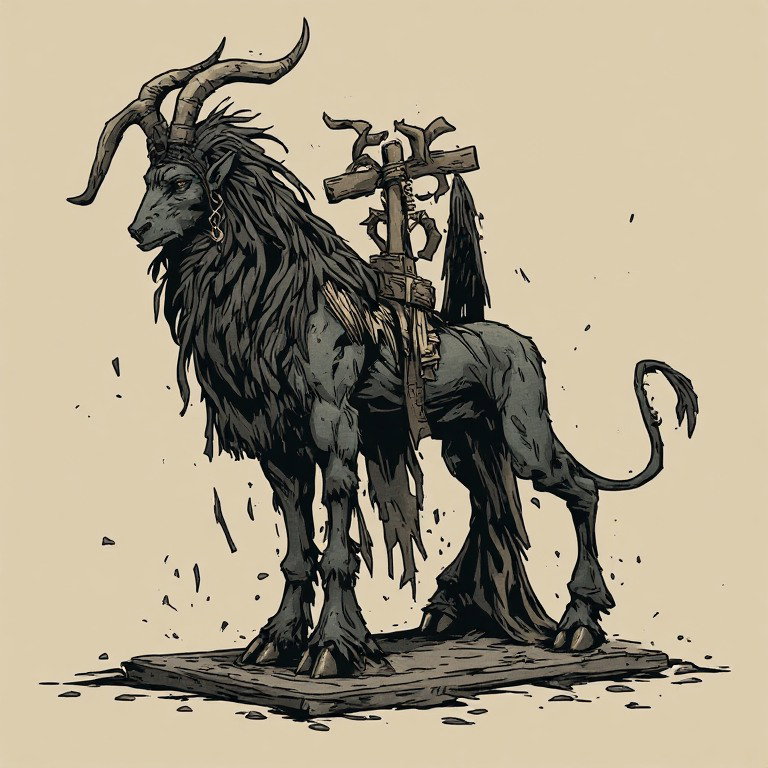
At the core of the human condition lies an unyielding existential orientation: humanity is fundamentally carved for worship, yet radically incapable of sustaining direct, unmediated devotion toward the transcendent, invisible Creator. Saint Paul’s diagnosis in Romans 1 captures a perennial anthropological mechanism: “Although they claimed to be wise, they became fools and exchanged the glory of the immortal God for images made to look like a mortal human being and birds and animals and reptiles... They exchanged the truth about God for a lie, and worshiped and served created things rather than the Creator.”
Human psychology and sociology reveal that the pure, unconditioned abstraction of an infinite, incorporeal God the Father is too vast, too terrifyingly silent, and too radically other for finite minds to grasp without collapsing under the weight of transcendence. Because the human psyche requires a mirror, something tangible, sensory, and proximate to reflect its own experience, it inevitably breaches the boundary of the uncreated. Driven by an innate compulsion to domesticate the divine, humanity continually fashions worship objects out of the fabric of creation.
This mechanism is not merely an ancient pagan error; it is a structural gravitation of the human spirit. When stripped of idols of wood and stone, the human imagination compensates by erecting conceptual, relational, and institutional idols. The historical trajectory of Western religion demonstrates that even within monotheistic frameworks explicitly dedicated to worshiping the Father alone, the gravitational pull toward worshiping the created, the tangible human, the visible institution, the localized form, remains an overwhelming and persistent reality.
The most profound manifestation of this anthropological impulse within the history of Christian theology is the gradual theological and liturgical elevation of Jesus of Nazareth from a fully human prophet, messiah, and servant commissioned by God into the ontological status of the Supreme Deity. In the synoptic traditions, Jesus resolutely deflected absolute, ultimate worship back toward the Father, famously querying in Mark 10:18, “Why do you call me good? No one is good, except God alone.” Here, Jesus demarcates a distinct boundary between the creaturely sphere, even a commissioned, spirit-filled human agent—and the uncreated divine essence of the Father.
However, over the course of the first few centuries of the Common Era, under the pressures of Hellenistic philosophy, Roman imperial politics, and the psychological necessity for a concrete, anthropomorphic focus of devotion, this boundary dissolved. The early Church councils, spanning Nicaea to Chalcedon, formalized metaphysical frameworks that integrated the historical, flesh-and-blood man of Nazareth directly into the Godhead. While framed as defending the mystery of the incarnation, this theological evolution satisfied a deeper, latent religious hunger: it provided humanity with a God who possesses a human face, a human history, and a relatable emotional profile.
By making the human Jesus the direct object of ultimate, unreserved doxological worship, Christian practice actualized the very dynamic Paul described in Romans 1. The historical figure through whom God acted, to whom God gave authority, and who subordinated his own will entirely to the Father (“Not my will, but yours be done”), was retrofitted into the Almighty. In doing so, the ultimate focus shifted from the invisible, sovereign Father to a deified human focal point, a supreme theological illustration of worshiping the creaturely manifestation rather than the transcendent origin.
For well over a millennium, this foundational shift manifested in myriad, highly sophisticated ways across Christian civilization. The compulsion to anchor worship in the tangible did not stop at the elevation of Jesus; it cascaded downward into an entire ecosystem of created intermediaries, institutional structures, and sacred materiality.
The Cult of Saints, Relics, and Icons: Throughout the medieval period and beyond, ordinary believers found the pure monotheism of the Father too remote. Christianity absorbed this vacuum by populating the sacred landscape with localized proxies. Human beings (saints), physical bones (relics), and painted wood (icons) became the focal points of daily devotion, prayer, and veneration. While theologians drew fine lines between latria (ultimate worship due to God alone) and dulia (veneration due to saints), the lived experience of the pews frequently blurred these categories, proving that the human heart naturally seeks proximate, visible entities to adore.
The Sacramental and Institutional Idolization: The Church as an institutional body, with its hierarchical priesthood, majestic cathedrals, and terrestrial authority, often usurped the immediate spiritual presence of the Father. The institution became so sacralized that questioning its structural integrity was treated as treason against God Himself. Here, the creation (a human religious apparatus) was invested with absolute divine attributes, demanding obedience and reverence that properly belonged only to the Creator.
The Modern Domesticated Jesus: In contemporary expressions of Christianity, this tendency persists in subtler, psychological forms. The historical Jesus is frequently refashioned into a therapeutic companion, a personal life coach, or a cultural partisan. By projecting modern political, social, and emotional desires onto the human figure of Jesus, believers worship a constructed image, a modern mirror of their own cultural identity, rather than the radical, demanding, and incomprehensible Creator of the cosmos.
The historical evolution of Christian worship serves as a monumental testament to the truth of Romans 1: humanity cannot comfortably inhabit a spiritual space that leaves the Creator as the sole, unmediated object of devotion. Whether through the metaphysical deification of the human Jesus, the veneration of intermediaries, or the sacralization of religious institutions, the pattern remains unbroken. The human creature, perpetually uneasy with the vast silence of the transcendent Father, continually reaches into the realm of the created to find a face, a form, and a familiar narrative to worship.
To understand how the dynamic of Romans 1, exchanging the unseen Creator for visible, created forms, became the defining pattern of religious history, one must examine it not as an isolated theological slip, but as an uninterrupted historical continuum.
Across millennia, human societies have repeatedly revolted against the psychological weight of pure, unmediated, invisible monotheism. Driven by an innate craving for tangibility, security, and immediate sensory assurance, humanity has continuously refashioned its understanding of the divine through local cultures, imperial ideologies, and institutional apparatuses.
Below is a chronological examination detailing how this pattern developed from antiquity through the ancient empires, into late antiquity, the Middle Ages, and the Counter-Reformation.
The narrative of ancient Israel presents the archetype of this religious conflict. Israel’s covenant was built upon an unprecedented requirement: total devotion to an invisible, unrepresentable God (YHWH) who forbade any physical image or localized proxy (Exodus 20:4–5). Yet, the historical record demonstrates that Israel continuously buckled under this standard.
The Golden Calf as Immediate Presence: In Exodus 32, when Moses disappeared into the cloud on Mount Sinai, the people did not abandon their desire to worship the God who brought them out of Egypt; rather, they demanded a visible focus: "Make us gods who will go before us." The Golden Calf was an attempt to domesticate the dangerous, transcendent God into a familiar, physical shape common to Ancient Near Eastern bull iconography.
Agricultural Immanence (Baal and Asherah): Upon entering Canaan, the Israelites were confronted with Baal (the storm and fertility god) and Asherah (the mother goddess associated with sacred trees and poles). YHWH felt distant and unpredictable, whereas Baal promised immediate rain for crops, and Asherah promised human and livestock fertility. For centuries, from the era of the Judges through the Divided Monarchy, Israelites engaged in syncretism. They did not necessarily reject YHWH outright; instead, they paired YHWH with Asherah or worshiped YHWH through the sensory rites of Baalism on the "high places."
As human civilization organized into vast empires, the instinct to worship the created shifted from localized agrarian deities to imperial structures, celestial bodies, and sacred kingship.
Egypt: The Sacralized Ruler and Cosmic Phantasm
Egyptian religion was entirely organized around the divine embodiment of creation. The Pharaoh was not merely a representative of God; he was the living incarnation of Horus and the son of Ra. Ultimate reality was experienced through tangible, created mediators: the Nile river, the sun, animal-headed deities, and the living king. When Amenhotep IV (Akhenaten) attempted a radical shift toward quasi-monotheism by outlawing the pantheon in favor of the sole, invisible power behind the solar disc (the Aten), the system collapsed immediately after his death. The human psyche rejected an abstract deity in favor of the familiar, visible gods and the divine human Pharaoh.
Babylon: Astrological Determinism and State Deification
Babylonian religion elevated the cosmos itself, specifically the stars and planets, into objects of divine agency. The Enuma Elish sacralized the state apparatus, placing Marduk at the head of the pantheon as the celestial mirror of the Babylonian king. To worship in Babylon was to worship the celestial mechanics of creation and the earthly empire that claimed to mirror them. The tower of Babel motif reflects this human drive: building an earthly, created structure to reach into the heavens, collapsing the boundary between creature and Creator.
Persia: Dualism and the Materializing of Light
While Zoroastrianism introduced a high form of ethical dualism centered on Ahura Mazda (the Wise Lord), it struggled to maintain abstract devotion among the masses. Over time, the uncreated God was routinely accessed through veneration of the sacred fire, light, and intermediary spirits (Yazatas), alongside the exaltation of the Persian monarch as the sacred, absolute representative of divine light on earth.
By the time of the Hellenistic era and the rise of the Roman Empire, the ancient world had perfected the art of projecting divinity onto the human form.
Anthropomorphic Religion: Greek religion humanized the gods. Zeus, Apollo, and Athena were magnificent, immortal human beings with human passions, vices, and virtues. God was no longer radically "Other"; God was humanity magnified.
The Imperial Cult: Rome synthesized state power with worship by divinizing its emperors. Beginning with Julius Caesar and Augustus, sacrifices were offered to the genius of the Emperor. The state itself, embodied in a living human being, became the supreme object of civic devotion and ultimate loyalty
It was into this deeply anthropomorphic Graeco-Roman world that early Christianity expanded. The historical Jewish Jesus had proclaimed the Kingdom of the Father, consistently directing ultimate glory to God ("Why do you call me good? No one is good except God alone", Mark 10:18). However, as Christianity severed its Jewish roots and embedded itself in Hellenistic culture, the pressure to provide a visible, divine human focus became overwhelming.
The Council of Nicaea (325 CE)
Under the authority of the Roman Emperor Constantine, who sought a unified religious ideology to solidify his empire, the Council of Nicaea was convened. The theological debate between Arius (who maintained that the Son was a created being subordinate to the uncreated Father) and Athanasius (who argued that the Son was homoousios, of the same essence as the Father) marked a decisive turning point.
By declaring Jesus to be fully God, co-eternal, and consubstantial with the Father, the Council formalized a radical shift:
The human agent sent by God was dogmatically integrated into the supreme Godhead.
The ultimate object of devotion was no longer solely the invisible Father whom Jesus worshiped, but the exalted, divine-human figure of Christ himself.
The philosophical tools of Greek metaphysics (ousia, hypostasis) were used to elevate a historical human figure into the eternal substance of the Deity, satisfying the ancient human hunger for an anthropomorphic God.
Following the fall of the Western Roman Empire, the instinct to worship created entities expanded into a vast medieval ecosystem of sacralized objects and institutions.
In the lived experience of the medieval peasant, God the Father remained an imposing, terrifying figure of judgment. To access grace, one did not go to the uncreated Father directly; one prayed to the Virgin Mary, venerated the bone of a local saint, bought an indulgence from the ecclesiastical hierarchy, or bowed before a physical icon. The creaturely sphere had completely blanketed the transcendent.
When the Protestant Reformation erupted in the 16th century, driven in large part by an iconoclastic desire to strip away these created intermediaries and return to a direct relationship with God, the Roman Catholic Church responded with the Council of Trent.
Rather than reforming these practices, Trent dogmatized and codified them as essential to the faith:
Confirmation of Relics and Images: Session 25 of the Council explicitly affirmed that images of Christ, the Virgin Mary, and the saints were to be placed and retained in churches, and that due honor and veneration were to be given to them.
The Sacramental System: Trent bound salvation irrevocably to seven physical sacraments administered exclusively through a human priesthood. Grace was no longer an unmediated spiritual relationship with the Creator, but a commodity mediated through physical elements (bread, wine, oil) and human institutional authority.
Transubstantiation: The Council reaffirmed that the physical elements of bread and wine become the literal body, blood, soul, and divinity of Jesus, leading to the practice of Eucharistic Adoration, where believers literally bow before a physical, created element of bread as God Himself.
From the altars of Baal in ancient Canaan to the decree of Trent, the trajectory remains unbroken. The human spirit, struggling to endure the vast, silent transcendence of the uncreated God, continuously constructs bridges out of creation itself, whether through physical idols, elevated human figures, sacred institutions, or dogmatic systems.
From the high places of Canaan where ancient Israel sought physical security through Baal and Asherah, through the imperial deifications of Egypt, Babylon, and Rome, to the metaphysical elevation of the human Jesus at Nicaea, the multiplication of saintly proxies in the Middle Ages, and the formal dogmatization of sacramental mediation at the Council of Trent, human history exhibits an unbroken psychological and theological impulse to reject the vast, terrifying silence of the uncreated, invisible God in favor of domesticating divinity through tangible, anthropomorphic, and institutional creations.